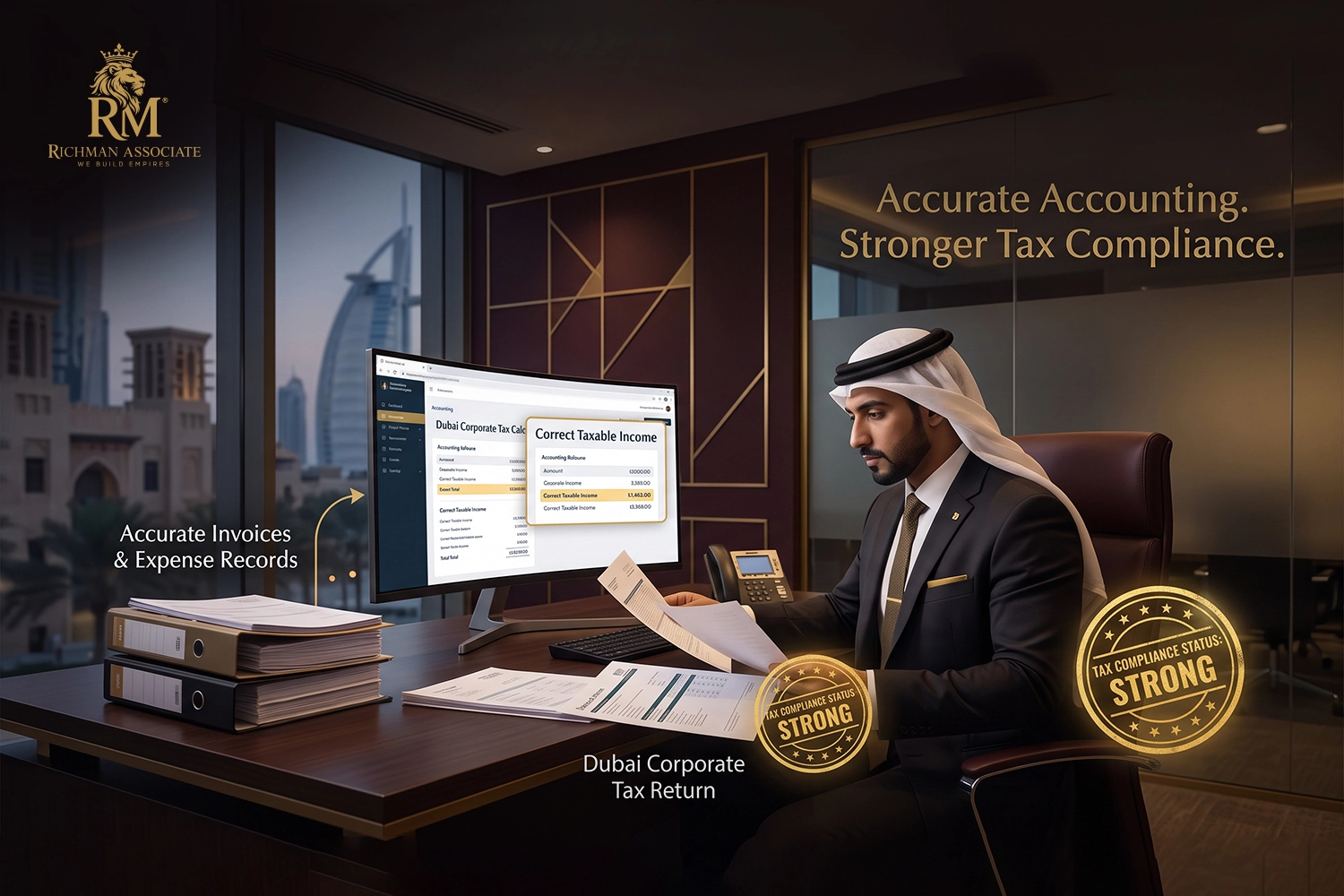
Proper accounting not only helps you align your financial obligations with the existing rules under the Corporate Tax Law, but it also helps you avoid administrative penalties. Incomplete or inaccurate accounting records can lead to:
- Incorrect taxable income calculations
- Unsupported deductions
- Filing errors
- Potential penalties
How Proper Accounting Supports Tax Compliance
supporting documents and financial data for accurate tax reporting. Proper bookkeeping also makes it easier to:
- Reconcile transactions
- Identify allowable adjustments
- Substantiate figures if reviewed by the Federal Tax Authority
Since businesses must retain records supporting their corporate tax returns, maintaining organised accounts is an essential part of avoiding preventable tax issues and reducing compliance risks. In this evolving regulatory landscape, it is of utmost importance to seek guidance from accounting services in dubai experts. At Richman Associate, our accounting professionals help businesses adapt to the new changes to the accounting laws and standards.
Consistent accounting practices also provide a clear audit trail. It helps you keep your supporting invoices and financial statements organized to ensure audit readiness and safeguards your business during any unexpected review.
Why Accounting Matters for Corporate Tax Compliance in Dubai
Accounting for corporate tax in Dubai is closely connected to corporate tax compliance because a business’s accounting forms the starting point for determining taxable income in the UAE (United Arab Emirates).
The Federal Tax Authority states that taxable income in the context of accounting and corporate tax in Dubai is generally based on accounting net loss or profit, followed by adjustments required under the corporate tax law.
The keys to easier tax return preparation in this context are:
- Accurate financial records
- Correct calculation of taxable income
- Proper expense classification
- Supporting documents
Maintaining accurate financial records gives businesses a reliable view of:
- Revenue
- Costs
- Assets
- Liabilities
- Transactions
Proper expense classification is equally important because legitimate business expenses may generally be deductible, while certain expenses may be partially or wholly require specific treatment.
How Proper Accounting Helps Reduce Corporate Tax Compliance Risks
Proper accounting helps reduce corporate tax compliance risks in Dubai in the following ways:
Accurate Calculation of Taxable Income
Properly maintained books give businesses a reliable basis for calculating taxable income. Under the UAE corporate tax regime, accounting net loss or profit is generally the starting point, after which specific tax adjustments are made.
Better Expense Classification and Documentation
Correctly classifying expenses helps businesses distinguish legitimate deductible costs from expenses that may be partially or wholly non-deductible. Proper accounting gives a better view of the financial health, cash flow, and the company’s profitability, thereby guiding the business towards building sustainable growth.
Easier Corporate Tax Return Preparation
Organised accounting records make it easier to reconcile financial information, identify required tax adjustments, and prepare the corporate tax return accurately.
Early Identification of Accounting and Tax Issues
Regular financial reviews and bookkeeping can reveal these before they affect a tax filing:
- Missing invoices
- Incorrect classifications
- Unreconciled transactions
- Unusual discrepancies
Key Accounting Practices Dubai Businesses Should Follow
The key accounting practices Dubai businesses should follow are:
- Regular bookkeeping for corporate tax compliance
- Bank reconciliation
- Accurate expense recording
- Proper invoice management
- Maintaining financial statements
- Organised accounting records
- Regular review of financial data
Dubai businesses should maintain consistent accounting practices to keep financial information accurate, organised, and ready for corporate tax requirements.
Regular bookkeeping services in dubai ensures sales, income, purchases, and expenses are recorded promptly rather than reconstructed later.
Bank reconciliation should be performed regularly to identify discrepancies between bank transactions and accounting records, and correct them quickly.
Businesses should maintain accurate expense records, with each transaction correctly classified and supported by documentation, such as appropriate invoices, payment records, and supporting documentation.
Proper invoice management helps businesses track expenses and revenue while making supporting evidence easier to locate.
Common Accounting Mistakes That Can Increase Corporate Tax Risks
The most common accounting mistakes that can increase corporate tax risks in the UAE are:
- Missing financial records
- Incorrect expense classification
- Poor bookkeeping
- Unreconciled bank transactions
- Missing supporting documents
- Last-minute accounting
As a business owner, you must keep these UAE corporate tax accounting requirements in mind at all times. Missing financial records can make it difficult to support figures reported in a corporate tax return.
Incorrect expense classification can also create problems.
Poor bookkeeping often results in outdated and/or incomplete financial information, making it harder to calculate taxable income accurately.
Similarly, unreconciled bank transactions can leave income, payments, or expenses missing altogether or incorrectly recorded.
How Businesses Can Strengthen Corporate Tax Compliance
Businesses in Dubai can take the following steps to strengthen corporate tax compliance:
- Maintain accounting records regularly
- Keep supporting documents organised
- Review financial records periodically
- Separate business and personal transactions
Work with qualified accounting professionals and providers of Corporate Tax Compliance in UAE when required.
Thus, they need to make accurate accounting an ongoing process rather than a year-end task.
They must maintain accounting records regularly by recording income, assets, expenses, liabilities, and other transactions promptly.
They must keep supporting documents organised by storing various records systematically:
- Invoices
- Receipts
- Bank statements
- Contracts
FAQs
How does accounting help with corporate tax compliance in Dubai?
Accurate accounting records for corporate tax give businesses reliable financial information for reporting and calculating corporate tax.
Why are accounting records important for corporate tax in the UAE?
Accounting records provide evidence for the figures reported in a corporate tax return.
What accounting records should businesses maintain for corporate tax?
Businesses should maintain financial statements along with records of transactions, liabilities, assets, and stocks.
Can proper bookkeeping reduce corporate tax compliance risks?
Yes. Regular bookkeeping helps businesses:
- Keep expenses and income accurately recorded
- Reconcile transactions
- Identify missing documentation
- Correct accounting issues before filing
When should a Dubai business review its accounting records?
Businesses should review their accounting records regularly rather than waiting until the deadline.
Conclusion
Proper corporate tax services in UAE gives businesses a stronger foundation for compliance by keeping financial information accurate, supported by appropriate records, and organised.
Since accounting profit generally forms the starting point for determining taxable income, regular reviews and consistent bookkeeping, accounting can help identify errors early. Moreover, it even reduces avoidable compliance risks, and support accurate tax returns. Businesses benefit from the financial expertise of the professional accountants while ensuring their financial responsibilities, avoiding legal hassles, and even establishing trust with their stakeholders,