
Corporate Tax Compliance in UAE gained significance with the introduction and later with the implementation of the new changes in the corporate tax regime. The new rules came into effect from June 2023. In this highly competitive business landscape, staying compliant with local tax laws is essential for businesses to streamline their corporate tax planning.
UAE Corporate Tax consultants assist businesses in navigating tax regulations, optimizing tax strategies, and ensuring compliance to save time and reduce liabilities. The role of corporate tax consultants is to bring their expert knowledge that helps protect businesses from any kind of regulatory risks.
Why has corporate tax changed business operations in the UAE?
Even though the announcement of 9% tax on profits exceeding Dh375000 still seems to be competitive in the global scale, there have been profound implications across different business sectors regarding the possibility of increasing operational costs, cash flow pressure and administrative burden.
While multi-national companies can integrate tax liabilities with active tax planning as UAE still has global minimum corporate tax requirements, there are considerable implications for startups and SMEs as they try to stay afloat in a much competitive market.
With the rules in place, the new corporate tax regime aims to bolster compliance and accounting structures so that companies comply with the new regulations. 9% federal corporate tax rate marks a crucial change in the fiscal policy of the United Arab Emirates. The impact of the new tax regime is felt across sectors as it has primarily influenced businesses of all sizes.
Before diving into any conclusion, it is essential to understand the role of professional corporate tax services in the UAE and how experienced compliance partners like Richman Associate help you navigate through this change.
Why Corporate Tax Compliance in UAE matters
From administrative perspective, the government of the UAE has aligned its tax rules with global tax standards and diversified revenue streams.
However, we need to understand that there are several reasons why corporate tax was introduced in the UAE.
The introduction of corporate tax aims to
- Provide economic stability
- Promote transparency
- Increase contributions from profitable companies
- Safeguards small businesses.
Now, strict compliance helps companies to manage the complexity in the tax rules and also avoid hefty fines. There are certain advantages too.
Let’s find out.
- Good compliance helps in keeping your trade license safe
- With clean and updated records, your business can attract both funding and investing partners.
- You can avoid penalties. Missed tax registrations and late filings can result in heavy fines.
All of above reasons makes Corporate Tax Compliance UAE a pre-requisite for businesses when it comes to financial planning, formal booking, compliance and tax registrations. Corporate Tax Registration UAE through expert guidance assists companies to manage complex rules and avoid heavy fines.
Common misconceptions on Corporate Tax UAE
Misconception 1- Free Zone Companies Are Exempt of Corporate Tax
Free zone companies do not automatically quality for 0% corporate tax. Qualifying Free Zone Person (QFZP) Status is not automatic. If you conduct business with clients in the mainland, you may not meet the qualifying income status. You need to maintain real operations, employees, office in the free zone.
The actual misconception in Business Tax UAE is related to “free zone” as a tax-free status. Companies in free zones can benefit from 0 % corporate tax rate evaluated on their qualifying income only if all the guidelines are classified as QFZP.
Misconception 2- Non-operational or dormant companies can skip registration
Companies, whether inactive or dormant still requires to register and then file zero returns to avoid any kind of administrative hassles.
Misconception 3-Corporate Tax is levied on personal income
Salaries through employment is not subjected to Corporate Tax. You need to know that corporate taxes are imposed on profits or income generated through taxed commercial activities. Therefore, any individual who receives salaries from private or public sectors are not required to pay corporate tax. Corporate tax is levied on natural persons or individuals, and freelancers who hold license to conduct business activities subjected under corporate tax.
Misconception 4- The 5% De Minimis Rule
The Federal Tax Authority allows “5% de minimis threshold” on the non-qualifying income. A free zone company can garner 5% of its total revenue from the non-qualifying sources and can maintain 0% rate. However, the company loses the entire exclusion if it crosses the “5% minimum threshold”. In such circumstances, the full taxable income will be subjected to 9% corporate tax.
Misconception 5-9% Corporate Tax applies to all income
The real tax structure shows that 0% tax applies to income up to AED 375000. The 9% tax rates only accounts on amount above that threshold.
For instance, if your business makes AED 390000 in taxable profit, you need to pay 9% on AED 15000 (the amount above the given threshold). That is AED 1666.66 in tax. The first AED 375000 is tax free. The tricky part here is that zero tax liability never means that you have zero compliance. You still have to register and file a tax return and maintain proper books for the same.
Misconception 6- Small Businesses are exempt from taxation
Small businesses are not exempt from paying the taxes if their taxable profit exceeds AED 375000 threshold. For small business owners, it is important to know the filing requirements, when to register, the ways to track their taxable income and maintain clean accounting books.
Why businesses need expert guidance
Professional Corporate Tax Compliance in UAE are important because they ensure compliance with the FTA rules and accurate filing under the 9% tax rate. With tax consultants providing the right guidance, companies can avoid costly penalties while optimizing their legal tax structure.
Strategic Tax Planning
Experts help businesses to manage the cash flow and even utilize the legal exemptions like the free zone rules.
Regulatory Compliance
With the changing FTA mandates and local laws, professional tax service providers play a pivotal role in helping businesses maintain regulatory compliance.
Accurate Tax Filing
Accounting experts ensure accuracy in calculation. Their timely submissions of financial records help prevent any steep fines.
Credibility
A transparent tax status helps businesses to build credibility and trust with global business partners and financial institutions.
Understanding UAE Corporate Tax Compliance
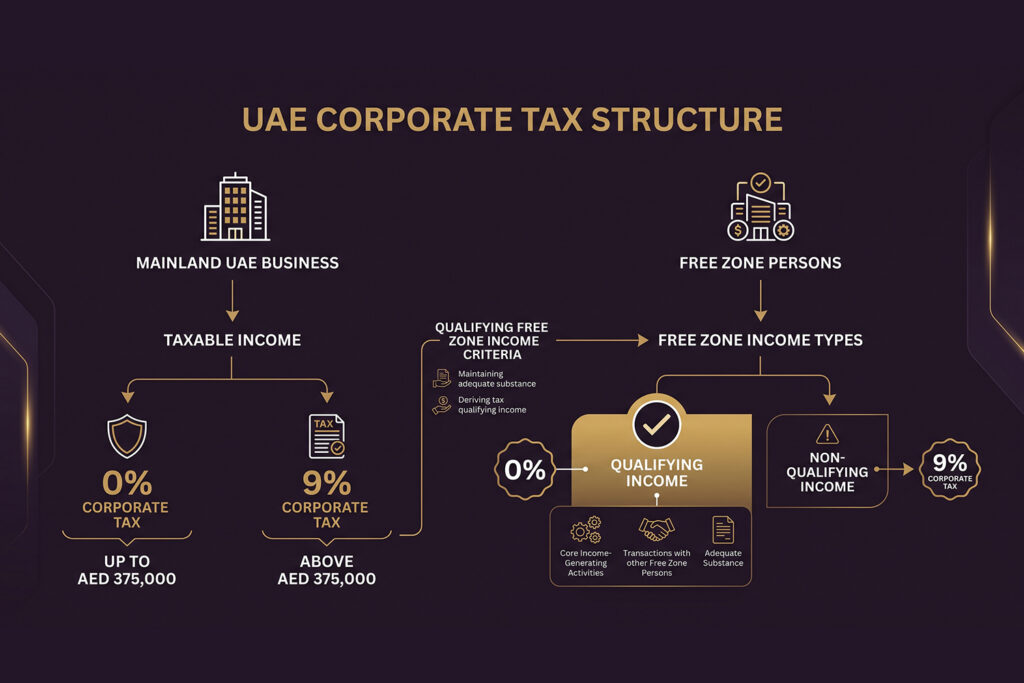
What is UAE Corporate Tax?
UAE Corporate Tax is termed as a “federal tax” on business net profits. According to the rule, a standard 9% tax rate is applied on taxable income exceeding AED 375000. UAE introduced corporate tax to meet the global standards that safeguard the country’s standing as a transparent and legitimate commercial hub. Hence, this credibility will benefit every organisation operating its base here.
Who should register?
The list of mandatory registrants or taxable persons includes
- Free zone entities
- Mainland companies
- Foreign entities with taxable presence
- Businesses conducting independent partnerships
- Individuals or natural persons who conduct commercial business activities within the country with yearly business turnover of excess of AED 1 million.
| Taxpayer Category | Corporate Tax Registration Requirement |
|---|---|
| Foreign Businesses | • Foreign businesses having permanent establishments and operating through an office, fixed place, or branch must register. • Non-resident foreign entities that earn income from immovable assets or properties in the UAE must also register for Corporate Tax. |
| Juridical Persons – Legal Entities and Companies | • Tax registration is mandatory for Free Zone entities even if they qualify for a 0% tax rate on qualifying income. • Free Zone companies must complete tax registration to obtain a Tax Registration Number (TRN). • All businesses incorporated as mainland companies, such as PJSCs, LLCs, or private joint stock companies, must register for Corporate Tax even if they have no revenue or profit. • Dormant, inactive, and holding companies that have an active UAE trade licence must also register. |
| Natural Persons (Freelancers and Individuals) | • Individuals working under a licence or permit, including freelancers or individuals engaged in any commercial activity, must register if their gross annual revenue exceeds AED 1,000,000. |
Tax rates
9% Tax Rate | This rate applies to all taxable income exceeding AED 375000 |
0% Tax Rate | This applies to taxable income of up to AED375000. This supports start-ups and small businesses |
15% Tax Rate | This pillar two tax rate applies in line with the OECD standards. This applies to large sized multinational companies that have consolidated global revenues exceeding EUR750 million. |
Free Zone Rate (0%) | This rate applies to the QFZP or Qualifying Free Zone Persons on their qualifying income. For this, certain regulatory substance requirements must be met. |
Corporate Tax basics
Why Businesses Need Corporate Tax Services
Corporate Tax Services in UAE help business owners to follow the existing rules, manage the tax duties and maintain a precise financial record. These services prove vital in many ways and cover every aspect of taxation starting from setting up regular bookkeeping, business registration and planning and filing official returns and tax payments.
The reasons businesses choose Corporate Tax Services in UAE are as follows:
- Avoid penalties – Legal notices, interest charges and heavy fines caused due to missed deadlines and accounting errors.
- Accurate registration – Setting up accurate tax identification numbers with local authorities to help set up your venture appropriately.
- Proper bookkeeping – Keeping records of your regular expense and income in an organized fashion to prepare final tax report for the authorities.
- Tax planning – Tax consultants help lower the tax bill utilizing their ways through smart timing, credits and valid deductions.
- Filing support – To prepare and submit the financial statements and tax returns appropriately before the cut off dates as set by the government.
- Record keeping – Keeping records of bank statements, invoices and other receipts for audit.
- Compliance – The tax consultants help your businesses to be in good standing. As experts, they protect your business reputation and help businesses to comply with the changing national and local tax laws.
Corporate Tax Registration Process
- Registration steps – Log in to create profile-Set up taxable person profile on dashboard-complete the form entering the valid license data, legal name, business activities, financial year start and end dates.
- Documents required – Proof of authorization (board resolution or power of attorney), Legal contracts like partnership agreements, Articles of Association (AoA) or Memorandum of Association (MoA), Valid Trade License, Emirates IDs and Passports, VAT TRN.
- Timeline – It takes around twenty fives to complete the submission directly on the FTA portal.
- FTA portal – This portal is operational 24/7
- Registration deadline – Within three months of incorporation.
Corporate Tax Compliance Requirements
Corporate Tax Compliance in UAE requirements necessitate maintaining accuracy in filing tax returns, financial bookkeeping and annual forms.
Corporate Tax Compliance UAE emphasises on core basics as mentioned below:
Documentation and Record maintenance | Maintaining log details of directors, members and even share transfers as part of their record maintenance of statutory registers. Keeping contract, invoices, tax records and even bank statements for about 7 years and till the end of the time period. UAE Tax Compliance also demands maintaining proper books of accounts and core data like retaining asset registers, general ledgers, payroll files and inventory loads. This means keeping record of sales and purchase lists, daily cash logs and ledger accounts too. UAE Corporate Tax consultants keep record of backing receipts and financial bills for a typical legal duration of 7-8 years to ensure access readiness and to produce any details if requested by FTA.
|
Financial statements
| These include preparing independent audits and auditor report with independent audit opinions as mandated under the law. These also involve preparing core reports like cash flow statement, profit and loss account and balance sheet. Using official statement to calculate the taxable income. Review and signing of the financial reports during formal meetings of the board of directors. |
Filing deadlines
| Filing the tax return online within nine months following the end of your financial year. |
Annual returns
| For relief claims, the tax consultants can help disclose the transfer pricing, free zone qualifying income and small business relief within the annual return |
Compliance responsibilities | Reconcile the tax number precisely against periodic VAT submission to ensure data accuracy. Filing the tax windows and meeting the registration timelines to prevent any heavy financial penalties. |
Common Corporate Tax Mistakes
The Federal Tax Authority has clearly stated the errors that can trigger heavy fines. Some of the common pitfalls include the following:
- Late registration – FTA maintains a designated timeline for registration. Any business failing to comply with the rules may be penalized. Late registration penalty can be AED10000.
- Wrong calculations – Any mismatch in net income and taxable income or glitch in adjusting non-deductible expenses could lead to further verifications from the FTA and even trigger heavy fines.
- Missing documents – one of the common mistakes that businesses make. It is mandatory to maintain and retain key financial records such as invoices, transfer pricing files for a minimum 7-year period.
- Ignoring deadlines – Missing the annual return filing window for over 9 months after the end of the financial year.
- Poor accounting – Accounting should be inline with international standards wherein all financial records need to be preserved. Not keeping the books could also result in fines.
- Assuming Free Zone companies automatically pay 0% tax – Operating within a free zone does not inevitably grant a 0% tax rate. There are certain conditions for Qualifying Free Zone Person (QFZP).
For instance, your financial records and statements need to audited and prepared under the rules of IFRS. To earn the qualifying income, the free zone business must comply fully with the transfer pricing rules. Businesses need to maintain some economic substance with the free zone. Additionally, businesses must meet the De Minimis requirement too.
Benefits of Hiring Corporate Tax Experts
Hiring corporate tax experts ensure audit readiness. Professional corporate tax experts provide expert guidance that reduces risks, saves time and facilitates business growth and improves tax planning. As specialists in corporate tax services in UAE, these accounting experts handle complex rules effectively while you focus on running your organization.
Core Benefits for Businesses
| 1. Tax Planning | Professionals specializing in Corporate Tax Services in UAE builds your strategies for better financial planning. An expert Corporate Tax Consultant UAE calculates and make necessary deductions that you might have missed. As professionals, tax planners build long term strategies to handle taxes better with strategy. |
|---|---|
| 2. Expert guidance | Tax codes could be tricky to understand. Corporate Tax Consultant UAE provides key insights for specific industry types. Their expert guidance helps to solve any financial hurdles fast. |
| 3. Saves time | With timely assistance, tax consultants with proper expertise on FTA Corporate Tax speed up and automate document gathering. It frees your internal team from the filing duties. This prevents the wasted hours on the shifting laws. |
| 4. Reduces Risks | A Corporate Tax Consultant UAE help you avoid legal penalties and late fees. They help in avoiding mistakes in calculation and keeps your filings legal and confidential. |
| 5. Business Growth | The experienced tax consultants can help in legally lowering overall tax overhead through smart choices. They provide you strategies to invest money into operations and that frees up the cash flow. |
Why Choose Richman Associate
Richman Associate has been in the forefront serving different businesses operating in the United Arab Emirates with corporate tax services. With extensive experience in providing corporate tax services in UAE that includes complete tax advisory and consultation services, our experienced consultants execute corporate tax planning in the UAE.
Our FTA compliance support help businesses to carry out corporate tax assessment with robust tax planning and strategy. Contact us today for registration assistance
and affordable corporate tax advisory services and other supporting end-to-end services to leverage on our tax relief measures.
FAQs
What are Corporate Tax Services in UAE?
Corporate Tax Services in the UAE prove indispensable for businesses to ensure strict compliance with the existing FTA rules and regulations. Such professional services help businesses in optimizing their financial records, prevent hefty legal penalties and keeping with global credibility and long-term growth.
Who needs Corporate Tax Registration?
Corporate Tax Registration is mandatory for all types of foreign and domestic businesses and corporate entities operating within the tax jurisdiction. The corporate tax rule even effect certain freelancers and individuals whose business revenue crosses the stated legal thresholds.
Is Corporate Tax mandatory in the UAE?
Corporate tax is mandatory for most commercial activities and businesses that include free zone businesses, mainland companies, and foreign entities. Individuals and businesses that operate under professional and commercial license must register and pay.
What documents are required?
The documents required for corporate tax registration include
- Address Proof (Email, Phone number, Official Business Address, PO Box),
- Articles of Association, Memorandum of Association (MOA)
- Certification of Incorporation, Copy of Commercial License (Trade License)
- IDs like copy of Emirates ID of authorized managers, business partners and owners. Additionally, an authorization proof like POA or Power of Attorney or document with authorized signatory is required.
Documents needed for corporate tax records and filing include active bank statements, general ledger showing detailed logs of all fiscal transactions, stock and asset register, and financial statements like balance sheets, cash flow and income statements.
How long does registration take?
The standard processing and approval time are typically 20 working days. In certain cases, FTA can
What happens if I miss the deadline?
The Federal Tax Authority enforces automatic late payment interest and administrative penalties on missing corporate tax deadline. The fine amount usually varies depending on whether you missed payment deadline, initial registration or annual tax return filing.
Do Free Zone companies need Corporate Tax Registration?
Yes, every registered juridical being or business in the free zone is mandated to apply for tax registration.
How often should Corporate Tax returns be filed?
Corporate tax returns in the UAE must be filed annually. The due date falls within the nine months from the end of the financial year or registered tax period.
Can Corporate Tax Compliance in UAE Services help reduce penalties?
Failing to comply with the specified rules related to corporate tax can lead you to incur hefty administrative penalties. According to the Cabinet Decision No 75 (2023), the list of penalties related to corporate tax have been clearly mentioned. This is the reason why companies turn to Corporate Tax Services for ultimate solution in corporate tax planning. With comprehensive corporate tax planning, any business can avoid penalties.