The UAE has established itself as a top destination for crypto companies. Backed by strong regulatory frameworks, end-to-end business support services, and a favourable tax structure, crypto companies have a safe, legal, and evolving environment to grow and thrive.
With clear rules for conducting different crypto activities like NFTs, Wallets, Trading and blockchain, a crypto license in the UAE is what a crypto business will require to enjoy 100% business ownership.
What Is a Crypto License in the UAE?
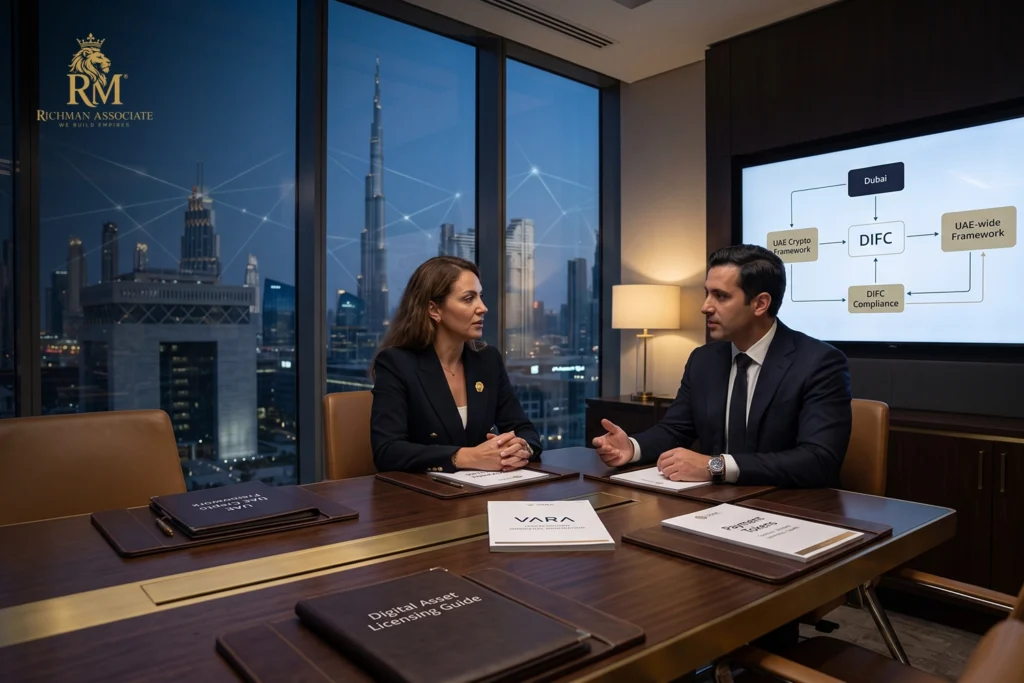
A crypto license in the UAE is a “regulatory authorisation” that allows a crypto business to conduct specified virtual asset or crypto-related activities in a particular jurisdiction in the UAE. It is not a UAE-wide, single license covering every crypto business. The applicable authorisation depends on the selected economic zone and activity type
In the United Arab Emirates, local and federal rules are applicable either independently or alongside each other, depending on the subject matter. So, crypto regulation in the United Arab Emirates primarily depends on the economic zone where you operate your business. You will require a crypto license in the UAE to issue tokens, operate a crypto exchange, provide digital wallets, and to trade crypto. Without the authorization, your business will be deemed illegal in the UAE.
Types of Crypto Licenses in the UAE
Crypto license UAE depends on the activity and jurisdiction.
VARA Regulated VASP Licenses
The Virtual Assets Regulatory Authority in Dubai (VARA), manages the licensing framework for virtual asset service providers since March 2026. VARA recognises 8 licensed activities and provides licenses for these registered activity types:
- Advisory services
- Broker-dealer services
- Custody services
- Exchange services
- Lending and borrowing services
- Management and investment services
- Transfer and settlement services
- Category 1 VA issuance
DMCC Crypto License
DMCC crypto license covers licensing requirements for main categories of crypto trading, crypto-related blockchain, and proprietary crypto trading. DMCC provides crypto licenses for the following company setups
- Metaverse services provider
- NFTs E-marketplace provider
- Proprietary trading in crypto commodities
- Distributed ledger technology services
Dubai International Financial Centre (DIFC)
DIFC provides limited crypto scope. It uses the DFSA’s Crypto Token framework for relevant financial services. DIFC firms conducting financial services involving crypto tokens fall under the DFSA framework, while certain payment token services are separately regulated by the CBUAE. DIFC allows licensed activities like
- Crypto funds
- Crypto advisory
- Limited trading activities
- Institutional services
Abu Dhabi Financial Free Zone
ADGM (Abu Dhabi Global Market) has its own FSRA (Financial Services Regulatory Authority) framework. The CBUAE works separately on payment token services. The licensed activities include:
- Custody services
- Market makers
- Trading platforms
- Crypto exchanges
- Institutional services
DAFZA crypto license
DAFZA allows a crypto license for proprietary trading in crypto commodities.
DWTC free zone crypto license
The issuance of a crypto license in the DWTC is overseen by the “Securities and Commodities Authority” and is accessible for the following activities.
- Distributed ledger technology services
- Proprietary trading in crypto commodities
Who Are the Main Crypto Regulators Working in the UAE?
A trade or business license does not, by itself, authorise regulated virtual asset (VA) activities. Many authorities across different jurisdictions oversee virtual assets. Every regulatory authority has its discrete role that regulates various aspects such as compliance, enforcement and licensing.
Getting a crypto license in the UAE (United Arab Emirates) requires a business to understand the “key regulators” within the jurisdiction based on their chosen activity. Depending on the specific “business activity” and “location” where you want to get your business started, regulatory requirements may include:
- Dubai’s VARA (VA Regulatory Authority)
- The DFSA (Dubai Financial Services Authority) for financial services involving crypto tokens in the DIFC (Dubai International Financial Centre).
- Capital Market Authority (CMA). This is the centralised financial regulatory agency. It regulates “virtual assets” across the country out of the financial free zones.
- Financial Services Regulatory Authority (FSRA) is the “financial regulator” of Abu Dhabi Global Market (ADGM). It regulates virtual assets and emphasises KYC and AML compliance with global standards.
- The CBUAE’s (Central Bank of the UAE) Payment Token Services framework
Therefore, you need to identify the following before you get started with your operations:
- Activity
- Jurisdictions
- Licensing route
- Costs
- Regulatory obligations
Who Needs To Apply For Crypto License in the UAE?
Any business entity considering engaging in virtual asset activities in the UAE needs to apply for the crypto license first.
- Crypto Advisors and Consultants
- Brokers and Dealers
- Custodians and Wallet Providers
- Issuers
- Stablecoin Providers
Licensing Requirements for Crypto Companies in the UAE
The licensing requirements are crucial for every business entity seeking to legally operate within the UAE. The requirements for a virtual asset license UAE vary by the “regulator” and “regulated activity”. Under VARA’s current application documentation, applicants may need:
- A UAE legal entity
- UBO (ultimate beneficial ownership) details
- Fit-and-proper senior management
- An organisational structure
- Governance framework
Applications may also require a:
- Regulatory business plan
- Financial projection
- Source-of-funds evidence
- Paid-up capital
- Available capital
- Applicable insurance
Operational crypto license requirements in the UAE include:
- Key personnel
- AML (anti-money laundering), CFT (combating the financing of terrorism), and KYC (know your customer) procedures
- Risk management
- Cybersecurity and technology controls
- Regulatory reporting where applicable
Eligibility Criteria for a Crypto License in the UAE
Whether you are eligible for a crypto or VASP license in UAE depends on your:
- Proposed virtual asset activity
- Jurisdiction
- Applicable regulator
If you want to set up the business outside Dubai, in the DIFC, VARA would need you to get authorised before you start conducting regulated VA activities. New companies need to set up the correct legal entity in Dubai. They must also provide clear UBO and ownership information. They also need to show these:
- Suitable governance
- Qualified and fit-and-proper senior personnel
- Financial soundness
- Relevant industry knowledge
- The ability to meet necessary regulatory, operational, and compliance needs.
How to Apply for a Crypto License in the UAE?
To start the process of applying for a cryptocurrency license in the UAE, you first need to define the VA activity that you have proposed to do. Then, you need to determine which jurisdiction and regulator will apply to it. After this, you need to set up the necessary legal entity and prepare these documents:
- Business plan
- Ownership and UBO information
- Governance details
- Financial information
- Compliance policies
For new companies based in Dubai, VARA follows a two-stage process – ATI (Approval to Incorporate) followed by the VASP (Virtual Asset Service Provider) license.
Crypto Company Registration in the UAE
If you want to register your crypto company in the UAE, you will first have to set up the correct legal entity and get a crypto license in the UAE. Alongside this, you will need to get the regulatory permission you need for your proposed VA activities.
If you are setting up the business in Dubai but outside the DIFC, you will have to set up a legal entity through DET (Dubai Economy and Tourism). You can also start your business in an eligible freezone company formation in dubai. Here, you will need to get the relevant VARA license as well before starting your business.
Crypto License for Foreign Investors in the UAE
Foreigners are also allowed to start a crypto business setup in the UAE, subject to the applicable regulatory requirements. VARA welcomes virtual asset firms from both overseas and the UAE. However, for this, you need to set up the correct legal entity. You also need to satisfy various VARA requirements.
This is especially true in areas like licensing, compliance, and governance. Just because you are from a certain country does not mean that authorities will surely approve your application. You and your proposed activities have to meet regulatory standards. That will determine if you get the license.
Who Issues Crypto Licenses in the UAE?
Where you get your crypto license in the UAE depends on the jurisdiction and your business activity. In Dubai, outside the DIFC, VARA regulates VA activities. It requires companies to apply for a VASP license before they start their business.
If your business is within the DIFC, you will have to apply to the DFSA for financial services like crypto tokens. The CBUAE works separately, focusing on payment token services. This includes their issuance, custody, conversion, and transfer. So, you need to first identify your jurisdiction and activity before you apply.
In the context of Dubai, SCA (Securities and Commodities Authority) also plays a major role.
What Are the Best Locations for Crypto Licenses in the UAE?
The locations for a crypto license in the UAE are:
- DMCC (Dubai Multi Commodities Centre)
- ADGM
- DIFC
- RAK DAO (Ras Al Khaimah Digital Assets Oasis)
All of these have attained these spots for various reasons.
For instance, the DMCC crypto license is a suitable choice for crypto trading, the metaverse, and NFTs (non-fungible tokens).
The ADGM crypto license is the ideal option for exchanges and large investors.
DIFC is suitable for businesses at an institutional level.
RAK DAO is ideal if you are looking to own start-ups and/or have little funds to begin with.
Why the UAE Rules Over the Global Crypto Landscape
The UAE has become one of the top crypto centres of the world. It has done so by combining devoted regulation with an environment that it has created to support digital asset businesses. Dubai has made VARA the specialised regulator for VAs. It covers all the free zones outside the DIFC and the mainland company formation in dubai.
The DIFC has a different system named DFSA. It looks at financial services like crypto tokens. Apart from these, you have federal rules that govern payment tokens and VA activities.
Costs of Setting up Crypto Business in the UAE
There is no single fixed crypto license cost in the UAE as such. It depends on the type of license, your business location, and your business model.
The table below reflects the other fees applicable in this context:
Cost Area | Estimated Cost in the UAE |
Company incorporation | AED 15,000 – 40,000 + |
Office requirements | AED 30,000 – 100,000 + per year |
Compliance | AED 100,000 – 300,000 + per year |
AML/KYC systems | AED 50,000 – 200,000 + per year |
Technology/security | AED 150,000 – 500,000 + per year |
Professional services | AED 75,000 – 250,000 + per year |
Visas, where applicable | AED 5,000 -10,000 per employee |
Capital requirements | AED 100,000 – 1.5 million +, depending on activity |
Kindly note and understand that these are just planning estimates, not regulator-prescribed fees.
Benefits of Crypto License in the UAE
The benefits of a crypto license in the UAE are:
- 100% foreign ownership
- Global reputation
- Access to local banking
- Legal protection
- Quick approvals
All these benefits help you in different ways.
For example, even if you are a foreigner, you do not need a local partner to set up your crypto business here. You can control it totally on your own.
UAE’s crypto regulations are respected all over the world.
Once you have the license, you can open corporate bank accounts so easily!
UAE Regulations for Cryptocurrency Businesses
In the UAE, cryptocurrency businesses need to follow these rules and regulations:
- KYC rules
- Travel rules
- AML regulations
- Reporting standards to authorities
Strategic Challenges and Important Considerations
Crypto businesses in the UAE need to be ready for:
- High compliance costs
- Complicated documents
- Lengthy approval procedures
- Local staff requirements
- Changing rules
However, if you hire a business setup consultant firm, all this should be a lot simpler and easier for you to manage.
How RichMan Associate Helps You
At RichMan Associate, we assist all types of proprietary crypto trading businesses with in-depth experience and understanding of the crypto regulations. With our team of business setup consultants, we streamline the whole process of business setup in dubai. We provide all kinds of assistance to help you start trading completely legally. We offer you end-to-end support in company formation, licensing, regulatory compliance, and in meeting all kinds of requirements like:
- Trade license
- VARA-approved setup
- Investor visa
- Corporate bank account
- Shared desk
- Health insurance
FAQs about Crypto Licenses in the UAE
How much does a crypto license cost in the UAE?
There is no single UAE-wide fee. The cost varies depending on your jurisdiction and business activity.
Who regulates crypto businesses in Dubai?
VARA regulates virtual asset activities in Dubai, excluding the DIFC, where the DFSA applies.
What documents are needed for a crypto license?
Documents can include incorporation records and UBO details.
Can foreigners get a crypto license in the UAE?
Yes. The country welcomes companies from both within and outside the country. However, you have to fulfil certain requirements so that you can get the necessary approval to start and run the business.
How long does it take to get a crypto license?
There is no fixed timeframe. It can take anywhere between two weeks and twelve months to get a crypto license. It depends wholly on your selected jurisdiction, document readiness, and regulatory maturity.