
“Is my corporate tax return due this September?” If your business is approaching its filing deadline, September 2026 is an important month to watch. The 30 September 2026 deadline applies to relevant taxpayers whose tax period ended on 31 December 2025.
However, the exact deadline depends on the tax period, with the general rule requiring filing within 9 months from its end. This article explains the current corporate tax return scenario of the United Arab Emirates. You will also know about the UAE Corporate Tax Return deadline, who needs to file, how to avoid late-filing penalties, and key requirements.
Is Your UAE Corporate Tax Return Due on 30 September 2026?
Taxable persons whose “financial years ended on 31 December 2025” must file their UAE Corporate Tax return and pay their corporate tax by 30 September 2026. This date follows the broader rule that taxable persons generally have 9 months from the end of their relevant tax period to file their returns and settle their corporate tax obligations.
Therefore, businesses should check their own tax period rather than assume 30 September applies to them. The FTA (Federal Tax Authority) advises timely payment and filing to avoid penalties. Businesses can use its EmaraTax platform for filing the corporate tax.
Who Needs to File a Corporate Tax Return in the UAE?
For a business owner, the basic rule of UAE Corporate Tax return is straightforward: UAE juridical persons that are taxable generally need to meet their corporate tax obligations, including filing a corporate tax return.
This can include relevant non-resident juridical persons that fall within the UAE Corporate Tax regime. Free zone persons are also within the corporate tax framework and must comply with applicable requirements, even when they may be eligible for specific free zone treatment.
Certain exempt activities or persons may have different obligations.
What Should You Prepare Before Filing Your UAE Corporate Tax Return?
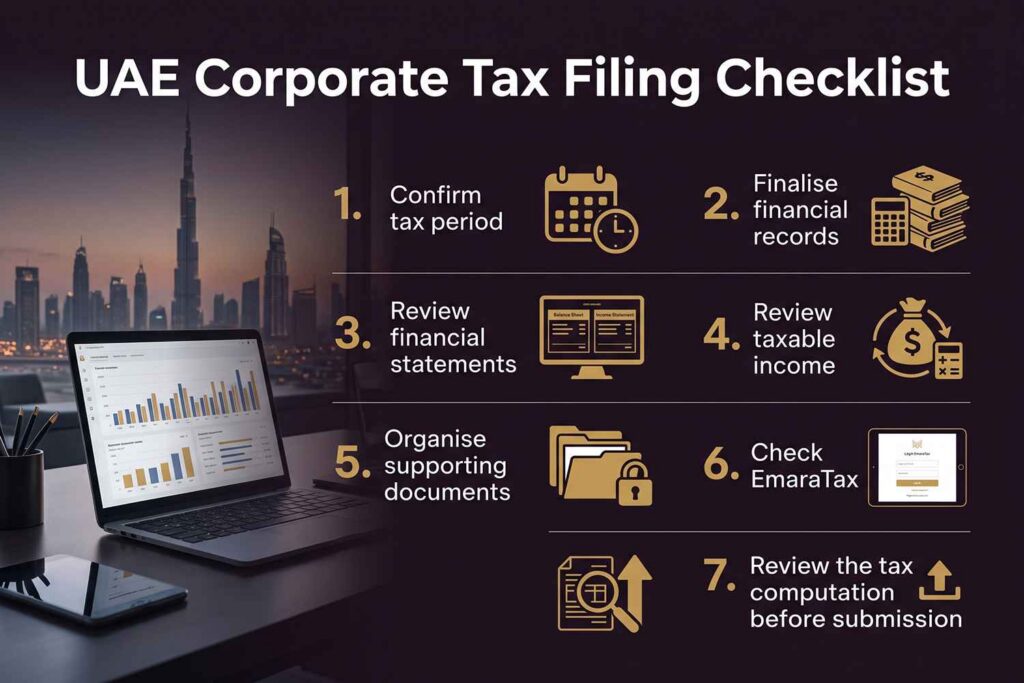
A smooth UAE Corporate Tax return filing starts with preparation rather than rushing to meet the deadline. Use this practical checklist:
- Confirm your Tax Period
- Finalise financial records
- Review financial statements
- Review taxable income
- Organise supporting documents
- Check EmaraTax access
- Review before submission
Businesses must identify the exact financial period covered by the return.
They must ensure transactions such as expenses and revenue are accurately recorded.
They must check whether unaudited or audited financial statements apply to their UAE business.
They must reconcile accounting profit with taxable income and identify relevant corporate tax adjustments.
Deloitte’s 2026 guidance similarly highlights:
- Financial-statement readiness
- Supporting documentation
- Taxable-income reconciliation
- EmaraTax preparation
Businesses that need professional assistance with corporate tax compliance can explore corporate tax services in the UAE from Richman Associate.
What Happens If You Miss the Corporate Tax Filing Deadline?
Missing the UAE Corporate Tax return filing deadline can lead to administrative penalties and particularly, where tax remains unpaid, additional financial consequences might follow. It can also increase compliance risk and may require your business to address outstanding obligations with the FTA.
Businesses should always check the current rules. Waiting until the final days can also leave little time to resolve EmaraTax issues or correct accounting records. Paying and filing timely is the safest approach, as per UAE Ministry of Finance Corporate Tax guidance.
How Can Businesses Avoid Last-Minute Filing Problems?
Businesses can reduce UAE Corporate Tax return filing stress by preparing well before the deadline. The FTA specifically encourages timely, accurate compliance and early preparation:
- Confirming the filing deadline
- Finalising accounting records early
- Checking financial statements
- Organising supporting documents
- Checking EmaraTax access
- Reviewing the tax computation
- Getting professional support if required
Businesses seeking help with their accounts can also consider accounting services in Dubai.
Frequently Asked Questions
When is the UAE Corporate Tax return due?
Generally, a taxable person must file a return and pay corporate tax within 9 months of the end of its tax period.
Who needs to file a Corporate Tax return in the UAE?
Taxable persons, including UAE juridical persons and relevant non-resident juridical persons, must generally file a corporate tax return for each tax period.
Do free zone companies need to file a UAE Corporate Tax return?
Yes, free zone businesses are obligated to file their returns on time. This rule apply to those businesses that even qualify for the 0 % corporate tax rate.
Do businesses using Small Business Relief still need to file a Corporate Tax return?
Yes, businesses using SBR are not exempt from filing a return.
What documents are needed for a UAE Corporate Tax return?
Businesses should maintain documents supporting the information reported in the return, such as:
- Financial statements
- Transaction records
- Asset and liability records
- Ownership information
What happens if a UAE Corporate Tax return is filed late?
Late filing can result in administrative penalties or late filing fines and create additional compliance concerns. AED 10000 is the baseline penalty for failing to register within time. Repeat violation in record keeping and inaccurate return can trigger higher administrative fines. However, there are temporary waivers and that applies if you complete filing the return within 7 months of the tax period.
Conclusion
How to file corporate tax in uae, Record retention is highly important for businesses to avoid penalties. Accounting and financial records needs to be maintained properly for compliance verification by authorities. This is where qualified accounting support helps you understand filing requirements, review records, and prepare for timely compliance. Explore the most comprehensive corporate tax services in UAE from RichMan Associate’s Accounting Team.